
Let's Use Ai in the Classroom!
Looking at implementation through the teaching lens

Ai Research I am Reading

There are loads of models out there for school adoption of AI and/or usage at schools. I even built one for my own school. As with everything, they either quickly become outdated or we simply find a better one. However, most of these do not have the research behind them to back the usage. That is where this journal article begins.
The researchers started like the rest of us and have now refined as well as conducted the research to show value. The revised AIAS features five distinct levels of GenAI integration, ranging from 'No AI' environments to the creative exploration of AI capabilities in 'AI Exploration'. This framework is grounded in social constructivist principles and prioritizes assessment validity, ensuring that evaluations accurately reflect students' genuine learning and skills.
The AIAS is not merely a set of rules but a tool to foster open dialogue between educators and students about the appropriate use of GenAI in education. It provides a structured yet flexible approach to assessment design that is, adaptable across different educational contexts. The researchers provide detailed implementation guidance and practical examples for each level of the AIAS, supporting educators in reimagining assessment in the age of disruptive technologies. As GenAI continues to advance, the AIAS is a valuable resource for educators committed to effective and transparent assessment practices.
Perkins, Mike, et al. The AI Assessment Scale Revisited: A Framework for Educational Assessment a PREPRINT the AI ASSESSMENT SCALE REVISITED: A FRAMEWORK for EDUCATIONAL ASSESSMENT a PREPRINT. 2024, media.licdn.com/dms/document/media/v2/D561FAQEgiWJWG-FI9A/feedshare-document-pdf-analyzed/B56ZO.M7ScGwAY-/0/1734062889156?e=1735171200&v=beta&t=lSmqt7X2j__Sk-J6lsv4fq4-VD0CrGZlv7T2Vw-dnxo. Accessed 16 Dec. 2024.
Ai Teaching & Instruction

Recently, I had the chance to work with an amazing Science teacher and her students to conduct an investigation about a current topic. The above image is linked the slide deck I used to teach this lesson that including Ai and Research. We used several tools and started with Ai to help with idea and question generation. Students found the Ai process of refining their topics super helpful. Rather than just searching generically for information they used the Ai to frame a question that they could actually conduct a simple experiment with as well as research to put together a solid set of evidence.
This was a project where we also leveraged one of my new favorite live internet search tools, Sooth.fyi. This is a growing database of information and articles that makes searching easy, creates citations, and allows for collections, and sharing. While these are all very typical for research tools, this one also includes a domain checker and a MisInformation finder. While these tools are in their infancy, the teaching of this skill is very timely (see below the Ai Digital Citizenship). This is a paid tool, however, you can get a 30-day trial and from my work, this one is going to challenge some of the old giants of the industry. Below is a highlight video - check it out!
Ai Trick
This one is less of a trick and just a fun exercise. I got caught up trying it and thought I would share it. The original was posted in the New York Times article by Stuart A Thompson on Dec. 27th. It is interesting to see just how easily one can be fooled by Ai Generated images. See how well you can do on their quiz.

Thompson, Stuart A. “Which Parts of These Images Are A.I.-Generated?” Nytimes.com, The New York Times, 27 Dec. 2024, www.nytimes.com/interactive/2024/12/27/technology/artificial-intelligence-generative-fill-photoshop-openai.html. Accessed 10 Jan. 2025.
Ai Technology Tool

Flint demo video (AI personalized learning platform for schools) - Watch Video
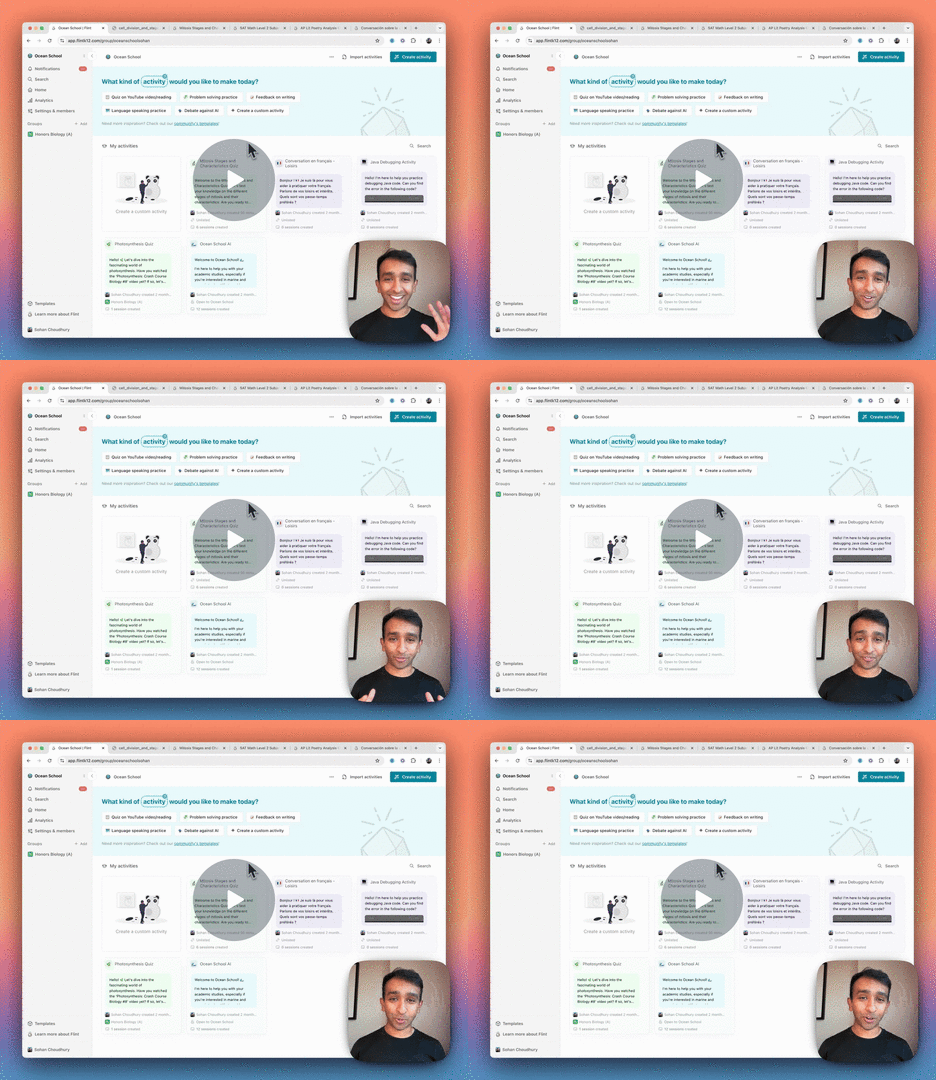
I do not work for Flint Ai but I like the work they are doing! Have you tried to create discussions in your classroom and struggled to capture or validate the students’ work? Look no further! Flint Ai is a very powerful Ai tool for schools. I cannot say I have used all of the features - they have loads - however, I have used it for discussion or Socratic seminars and it was a game-changer. With Ai as part of the discussion, students interact with it and each other enriching the conversation along the way. My job was to simply be another member of the discussion. Flint helped me sort out the nebulous part of assessing a conversation by identifying individual inputs so that it was clear and easy to ‘see’ how everyone was communicating. In addition, it captures all of this for you to either share back with the students or even grade as part of the activity. This is only part of what Flint can do. It can put questions to a YouTube video, Feedback on Writing, and much more. Check out Flint Ai!
Ai Digital Citizenship

Earlier this week Meta announced the end of their Fact Checking program. Whether you agree or disagree with this move by the social media giant, it was never a perfect process. In a world that is full of misinformation and with Ai creating many articles now that inherently have misinformation the ability to be your own fact checker is a skill we all need.
In this article, Professor, Stephanie Jean Tsang, gives us four simple steps to take to start weeding out fact from fiction. The steps are:
Check for Potential Pitfalls - Avoide Click-Bait or Too Good to Be True Headlines
Check Whether it is Fact or Opinion - Look for stats or figures that can be verified
Check Related Information - Conduct a quick search to see what else is out there on the topic
Check the Original Source of the Information - Most people get their information via a news feed or social media - check the source
While there still is not a perfect solution to the problem of misinformation, being knowledgeable about how you can methodically check information validity is a skill to teach students and share with friends.
“A Four-Step Process to Transform Everyone into a Fact-Checker.” THE Campus Learn, Share, Connect, 10 Jan. 2025, www.timeshighereducation.com/campus/fourstep-process-transform-everyone-factchecker. Accessed 10 Jan. 2025.
Book Recommendation

Stone Yard Devotional by Charlotte Wood
This was the second to last of the Booker Prize Shortlist books that I wanted to read. This book is very different from the rest in that it seems that it is going to be religious however, it is more about the characters coming together and how we deal with death. In the story, our main character seems the last person to become religious as she struggles to believe in anything. Yet she joins a convent to nuns. While she learns to deal with this new group of interesting people she also learns about herself and what her own strengths are.
One of the ways, we get a look at death is via a plague of rats that have infested the abbey. It is something the nuns are forced to deal with and at the same time are repulsed by how they have to deal with the dead. They symbolize the plague falls right in line with how our main character faces the death of those she loved. This book even has a Thailand link as one of the nuns is dealing with human trafficking. This book has adult themes but I promise it will make you think.